Frequently Asked Poly Bag Questions:
What different materials are most poly bags made of?
- Low
Density Polyethylene (LDPE – also simply known as “poly”)
This is probably the most common type of bag.
An example of LDPE bags would be your standard sandwich bags you buy at
the grocery store. It is flexible and
tough, but is breakable, and comes in a variety of thicknesses and sizes. Most LDPE bags are USDA and FDA
approved for food storage. Polyethylene
is translucent and prohibits a greater amount of light from penetrating,
subsequently making it the preferred choice for archival storage of printed
materials. It has a low static charge,
meaning that it will attract less dirt, dust or other foreign elements than
other materials.
- Linear
Low Density Polyethylene (LLDPE)
Similar in appearance and feel to LDPE, LLDPE is a stronger variant of a
polyethylene bag. It has more puncture
resistance and resilience than LDPE, is very flexible and stretchy, offers better
resistance to heat and cold, all while not needing to be as thick as a
comparable strength LDPE bag. It is not
as easy to process as LDPE and can therefore be more expensive, has a lower
gloss, and a narrower range for heat sealing.
- High
Density Polyethylene (HDPE)
HDPE is most commonly seen in retail bags like you get at the grocery or drug
store, or in trash can liners. It has
very little clarity and is thinner and very “crinkly” compared to LDPE
(standard poly) which is smoother and has very good clarity. The advantage of HDPE is its high strength to
density ratio – meaning that it can be very strong while still being very
thin. It has less flexibility than LDPE
and can withstand higher temperatures for short periods.
-
Polypropylene
(polypro or LDPP)
This is most common for food products and for presentation quality. It is a high clarity bag that provides a
protective barrier against moisture and vapors, which helps delay evaporation
and dehydration to preserve freshness and taste of food products. It is fully transparent. They are ideal for food storage, clean room,
electronics, and other applications. It
is stiffer and more “crinkly” than LDPE and has a slightly rougher
surface. It is not flexible or
tear/puncture resistant. All polypro
bags meet FDA and USDA specifications.
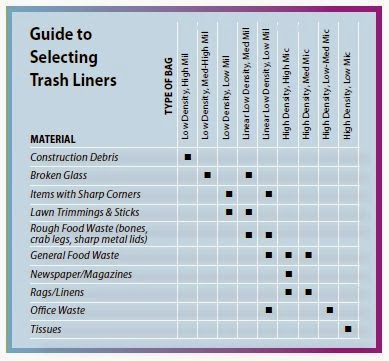
Which type of bag material do I need?
What is most important to you:
| Strength and resistance to tear/puncture | LLDPE, LDPE |
| Clarity and presentation | PolyPro |
| Flexibility and toughness | LDPE or LLDPE |
| Strength and affordability | HDPE |
| Food storage (long term) | PolyPro |
| Food storage (short term) | LDPE or PolyPro |
| Can/Bin liners | HDPE or LDPE |
| Retail merchandise bags | HDPE or LDPE |
| Affordability, effectiveness, and diversity of applications | LDPE |
| FDA/USDA approval | LDPE or PolyPro |
| Archival storage of printed materials | LDPE |
| Heat sealing | LDPE & LLDPE are ideal and most common. Others are dependent upon the machine and bag thickness |
Please note that these are guidelines only, and that there are no definite rules. It all ultimately depends upon your application and individual needs. Samples can be helpful to enable you to determine what material works best for you.
What
type of bag size options are there?
Lay Flat
Measured W x L
These bags only have two dimensions, width and length (always referred to
in that order). The width is also the
measurement of the bag opening. Lay flat
bags are best for products that have very little thickness/depth.
Gusseted
- Side Gussets
Measured W x D x L
These are the most common types of gusseted bag. The gusset is the depth of the bag, giving it
the ability to expand in order to contain larger contents with a significant
thickness or depth. The easiest example
of a gusseted bag would be the brown lunch bags, which have side gussets. Side gussets fold inward to allow the bag to
collapse flat, but expand to allow for larger contents. The measure of the gusset references the
fully extended depth of the gusset.
These bags are available case-packed (individual bags) or on rolls
(perforated), and are not available as reclosable/zip closure bags.
-
Bottom Gussets
Measured W x L + D
These are best when you need a reclosable gusseted bag, one that may stand
up on its own once filled, and where the contents may be heavier than
average. Bottom gussets expand at the
bottom, rather than the sides. The most
common examples of bottom gusset bags are reclosable food/pet food
products. These are available case-packed
only, and are available with reclosable/zip closure options.
How do I know what thickness I need for
my poly bag?
Mil
Thickness
Poly bags are measured by mil thickness.
1mil = .0254mm or .001in or 100 gauge.
For example, a standard retail sandwich bag is typically approx .75mil
thick, while standard reclosable retail zip top bags are 1mil. The larger the number, the thicker the
material. The thickness is usually
denoted as either “2mil” or “.002”.
General
Guidelines for LDPE Poly Bag Thickness
o
The heavier the contents, the thicker the bag
o
The greater the puncture potential, the thicker the bag
o
With polyethylene bags (LDPE ), greater
thickness = lower clarity
Mil
Thickness Suggestions for LDPE Bags
o 1mil Lightweight, economical short term storage
o 1.5mil Lightweight protection from dirt and
moisture
o 2mil Protection for shipping and storage
o 3mil Additional protection for hardware,
fasteners, and industrial components
o 4mil Heavy duty protection with puncture
potential
o
6mil
Extra heavy duty protection for high weight items and those with particularly
high puncture potential
Determining
thicknesses of can liners (HDPE, LLDPE)
o
.40 - .55 Mil – Regular Refuse
o
.55 - .65 Mil – Medium Refuse
o
.65 - .80 Mil – Heavy Refuse
o
1.5 – 2.0 Mil – Extra Heavy Refuse
What options are there for sealing a poly bag?
Heat
Sealing
Heat sealers offer a secure seal for polyethylene and polypropylene bags up
to 6mil thick and up to 24” wide. Many heat sealers come with a 30-day warranty, require no warm-up period, and
use electricity only when the sealing bar is down. Options include hand sealers, manual foot-operated
sealers, and automatic sealers, with or without trimmers. Each heat sealer creates a seal that is both
water-tight and air-tight. Using a heat
sealer creates a permanent seal that cannot be reused.
Reclosable/Zip
Top Bags
Reclosable zip-top bags are lay flat or bottom-gusseted and range in thickness from
1mil to 6mil. Most zip top bags
are FDA approved and offered in polyethylene or polypropylene. There are generally three types of zip top reclosable
bags:
o Standard Single-Track Reclosable Zip Tops
These offer a standard single zipper closure, similar to retail zip top
sandwich bags
o Double-Track Reclosable Zip Tops
These bags offer a double-zip closure that assures an extra-secure seal
o Slider Top Reclosable Zip Tops
Slider top bags are ideal for bags that need to be accessed
repeatedly. They are easy to use and
access, even with gloved hands. The
slider assures as much as possible that the seal is complete and secure.
Lip and
Tape Closures
A lip and tape closure is similar to an envelope closure where there is a lip
that extends over the opening of the bag and which has a tape strip that, when
folded down to the bag, creates a seal.
Lip and tape closures can be permanent or reusable.
Draw String
Closure
Double-pull drawstring bags open easily and provide a secure closure as
well as a convenient means of hanging the bag.
They can be reused multiple times.
They are ideal for content that needs to be accessed repeatedly and
easily and in a way that will eliminate fall-out possibility.
Ties and
Tape
Common options include vinyl and paper twist ties as well as nylon cable ties,
self-locking adjustable plastic ties, and bag sealing tape. Each of these offers an easy and affordable
means of sealing any type of bag. Of
these, only the nylon cable ties and the bag sealing tape are not reusable.
What is the best type of bag or tubing
to use for shipping sensitive electronics and components?
Metallic
Static Shielding Bags
Best for static sensitive components that are handled outside of an
Electrostatic Protected Area (EPA).
These form an effective Faraday Cage around the contents (a Faraday Cage
is when the bag is slightly conductive and forms a shield around the contents
to protect any discharges from bei
ng deposited on to the protected device
during the handling process).
These bags
should not be creased or used if there are any tears or punctures as it can
reduce the integrity of the shield/Faraday Cage.
The effectiveness of the bag can also deteriorate
with use, so when in doubt, it is best to use new bags.
Our static shielding bags meet the electrical and
physical requirements of ANSI/ESD S541 and are EIA 625 and ANSI/ESD S20.20
program compliant. Tested per
MIL-STD3010 4046 and ANSI/ESD STM11.11.
BlackConductive Bags
These bags should only be used in an Electrostatic Protected Area (EPA) and
while the handler is grounded.
It is
possible that contents could be damaged by contact with an electrostatic
discharge (ESD – an uncontrolled surge of static between objects with different
voltage).
Our black conductive bags meet the requirements
of MIL-P-82646 Rev B
Pink
Anti-Static (PAS) Bags
PAS bags are the only acceptable poly bag in an electrostatic protected
area and offer no effective protection against a contact electrostatic
discharge. They are best used for
non-static sensitive components, such as nuts and bolts. Standard poly bags may generate and hold
static charges greater than 10,000v, making the PAS bags a highly practical
option. PAS bags are also
amine-free. The effectiveness of
anti-static bags can deteriorate over time, so when in doubt, it is best to use
new bags.
Our PAS bags meet the static decay requirements
of MIL-PRF-81705E, Type II and EIA-541.
Bags 4mil and thicker are engineered to provide a surface resistivity
less than 1x10¹² ohms/sq.
Guides to measuring for the correct bag
size:
Polyethylene vs Polypropylene
|
Polyethylene
|
Polypropylene
|
Clarity
|
Good (decreasing with thickness)
|
Excellent
|
Translucent (prohibits more light)
|
Transparent
|
FDA/USDA Approved
|
Yes
|
Yes
|
Heat Sealable
|
Yes
|
Yes
|
Flexible
|
Yes
|
No
|
Puncture Resistance
|
Good (depending upon thickness)
|
Fair
|
Food Storage
|
Good
|
Excellent
|
Stock Thicknesses
|
1 mil – 6mil
|
.8mil – 3mil (1.5mil standard)
|
Archival Storage
|
Excellent
|
Good
|
Surface Texture
|
Smooth
|
Rough (relatively)
|
Static Charge
|
Low
|
Higher
|
Chemical Resistance
|
Good
|
Excellent
|
Melting Point
|
Low
|
High
|
Contact us today for more information and to answer any questions you may have regarding what bag type will work best for your needs and your budget. We have a wide variety of stock bags and can custom make almost anything, depending upon your budget and quantity needs. Look at
our post on custom and printed bags for more information on this option.
 For businesses who store their product outdoors, it is important to make sure your product is protected from the harmful rays of the sun. UV rays can harm your product and can deteriorate the effectiveness of the stretch wrap or poly bags surrounding your product as well. The further south you go, the more important UV protection is, but keep in mind that it's not the heat that does the damage, it's the unseen and unfelt UV rays, that are just as harmful in the winters of Minnesota as they are in the summers of Florida.